
Uranus in Astrology: The Planet That Blows Up Your Life (On Purpose)
Some links are affiliate links. We may earn a commission at no extra cost to you.
I represent the sudden and unpredictable changes that occur in your life. They are not unpleasant unless you try to resist me totally.
💡 Quick Answer: Uranus in astrology is the planet of freedom, disruption, and sudden change. It shapes how you handle independence in love, why you resist being contained, and where your life keeps getting reinvented whether you planned for it or not. Your placement shows where you’ll always need room to breathe.
Why Uranus Matters More Than You Think in Love and Relationships
You know that moment when you blow up a relationship that looked perfect on paper? Or when you suddenly need space from someone you genuinely love, with no warning and no real explanation? That’s Uranus talking. Most people blame themselves for being inconsistent or commitment-phobic. But sometimes the real issue is that your Uranus placement is running the show, and nobody ever told you.
✨ Still have questions about your situation? Get a personalized reading for just 99¢
Uranus stays in each sign for about seven years. This shapes a generation’s views on freedom, change, and what feels normal. But where it lands in your personal chart? That’s where things get specific. That’s where you learn why you often reinvent your relationships. Sometimes, closeness feels like a cage, even with love. You also discover why you’re attracted to connections that others find puzzling.
This planet doesn’t do subtle. It either shows up in your life as sudden insight or sudden chaos, and the difference between those two usually comes down to whether you’re working with the energy or against it. Understanding your Uranus is one of the more useful things you can do for your relationships.
What Does Uranus Represent in Astrology?
Uranus is the planet of disruption. Not disruption for its own sake, but disruption as a correction dynamic. Uranus rules revolution and sudden change. It shows the point in our minds when the status quo feels unbearable. It’s the part of you that recognizes when something isn’t working long before your conscious mind is ready to admit it, and then eventually forces the issue. Sometimes gently, usually not.
It rules Aquarius in modern astrology, and that connection explains a lot. Aquarius is the sign most concerned with what should exist rather than what does, and Uranus is the force that moves reality in the direction of what should be. That’s why both carry this combination of cold detachment and radical idealism. They’re not indifferent. They’re operating from a longer view than most people are comfortable with.
Uranus is also the planet of individuality. Which means it governs the part of you that cannot be fully absorbed into any group, relationship, or role. It takes about 84 years to complete a full orbit around the sun, spending roughly seven years in each sign. That long cycle is why Uranus placements say something about generational patterns as much as personal ones.
In the birth chart, Uranus shows where you’ll resist being contained. Where you’ll keep needing to break the mold, even when breaking it costs you something.
The Core Meaning — What Uranus Rules Over
Uranus rules innovation, rebellion, and the need for freedom at a structural level. It governs technology, sudden breakthroughs, and the kind of insight that arrives without warning and changes everything.
It also rules the 11th house, which covers friendship, community, and future vision. That connection runs deep because Uranus is fundamentally forward-facing. It’s less interested in what is and more concerned with what’s possible. It governs genius and eccentricity for the same reason: both involve seeing outside the frame everyone else is operating in.
How Uranus Shows Up in Your Personality and Relationships
You might notice Uranus in yourself as the part that needs an escape hatch in every situation. Not because you want to leave, but because you can’t relax unless you know you could.
In relationships, this shows up as a strong need for breathing room, an allergy to rigid expectations, and a pattern of pulling away right when things get comfortable. You love people. You just need to love them on terms that leave you room to remain yourself. The challenge is that most people don’t understand that need until it’s already pushed them away.
The Mythology and Symbolism of Uranus
In Greek mythology, Uranus was the sky itself, the first god, the vast and impersonal expanse above the earth. He was the father of the Titans and the grandfather of the Olympians.
This makes him a key figure at the start of power, before the famous gods appeared. What makes his myth interesting for astrology is how it ended. His own son Cronus overthrew him, which is fitting for a planet that represents the force that disrupts established order. He was the establishment, once. Then he became what gets overthrown.
That cycle — generating something, then being displaced by it — is exactly how Uranian energy works in real life. You build something new, and then something newer comes along to challenge it. The planet never lets any single idea or structure become permanent. That’s not cruelty. That’s the mechanism. Uranus keeps things moving because stagnation, in the Uranian framework, is actually the more dangerous state.
The planet was the first to be discovered with a telescope rather than the naked eye, in 1781, right in the middle of the American and French revolutions.
That timing is not subtle. It arrived in human consciousness precisely when the old orders were being dismantled and replaced. Astrologers consider that discovery moment part of the planet’s signature. Uranus showed up when humanity was ready to see beyond what had always been visible.
The Glyph, the Energy, and the Vibe
The Uranus glyph looks like a capital H with a circle sitting on top of it, sometimes depicted as a globe with an antenna. That image holds. Uranus receives signals other planets don’t.
It picks up on frequencies that haven’t become mainstream yet. The energy is electric and a little impersonal. Not cold exactly, but operating at a frequency that doesn’t always match everyday human warmth. More like lightning than candlelight.
How to Find Uranus in Your Birth Chart
Pull up your birth chart. You need your exact birth time if you have it, your birth date, and your birth location. Look for the symbol that resembles an H with a circle on top. The sign it’s sitting in tells you the style of your Uranian energy. The house it’s placed in tells you where that energy shows up most persistently in your life.
Because Uranus spends seven years in each sign, everyone born within roughly the same seven-year window shares the same Uranus sign. That’s the generational layer. Your peers all have some version of the same relationship to freedom, change, and disruption. What makes your placement personal is the house it falls in, the aspects it makes to other planets, and how strongly activated it is in your chart overall.
If Uranus is close to your Ascendant, Midheaven, or Sun, it stands out. This placement affects your personality, and others can notice its impact. If it’s tucked away in a quieter house with few major aspects, it may show up more in specific areas of life rather than coloring everything you do.
Strong Uranus placements often show up as people who are genuinely hard to predict. They’re not trying to be mysterious; they just think using a different logic than those around them. Getting to know your Uranus placement is mostly about understanding your own version of that logic before it surprises you.
What Your Uranus Placement Actually Means for How You Love
Where Uranus sits in your chart points to where you’ll resist being pinned down, even in relationships you want. The house placement shows which life area keeps getting disrupted and reinvented. The sign shows how that need for freedom expresses itself stylistically.
Feeling torn between loving someone and wanting to escape their closeness? That’s the Uranus tension. Learning to ask for what you actually need. Space, flexibility, room to be weird, rather than just disappearing is where the growth is.
Uranus Through the 12 Zodiac Signs — What It Means for You
Uranus in Aries You need to break new ground, and you need to do it your way. Your version of rebellion is personal, instinctive, and fast. You don’t wait for permission to change course, which makes you exciting to be around and occasionally exhausting. In relationships, you bring fire and initiative, but you’ll push back hard against anyone who tries to slow you down or manage you.
Uranus in Taurus
You resist change right up until you don’t, and when you finally flip, you flip completely. Your relationship with freedom is tied to security, which creates an interesting tension. You want stability and you want it on your own terms, which sometimes means blowing up what you have because it stopped feeling like yours. Building flexible structures rather than rigid ones is where you find relief.
Uranus in Gemini
Your mind is where the revolution lives. You think in ways that connect ideas nobody else thought to connect, and your relationships reflect that. You’re drawn to people who can keep up mentally and you lose interest fast when they can’t. Freedom for you is intellectual — the freedom to explore, question, and change your mind without having to justify it every time.
Uranus in Cancer
Your need for independence shows up inside your most intimate spaces: home, family, and emotional security. You’re rewriting what those things mean, often in ways your family of origin wouldn’t recognize. This can make relationships feel complicated because you want closeness and reinvention at the same time. The instinct to protect yourself by keeping one foot out the door is real, and it’s worth examining.
Uranus in Leo
You need to be original. Not just different. Genuinely, visibly, unmistakably yourself, and you want that self to be seen. This makes you magnetic and a little difficult to love consistently because your self-expression keeps evolving. In relationships, you need a partner who applauds the new versions of you rather than grieving the old ones.
Uranus in Virgo
Your rebellion lives in the details. You see inefficiencies and outdated systems everywhere, and you feel compelled to fix them. In relationships, this can come out as restlessness when things feel stagnant or when routines stop making sense. Your version of freedom is the freedom to improve, to refine, to make things work better. Perfectionism and unpredictability are an interesting combination.
Uranus in Libra
You’re rethinking partnership at the root level. The standard relationship model may never have fit you, and you’ve probably felt that friction your whole life without having a name for it. You’re drawn to connections that are equal, honest, and unconventional in some way. The trap is avoiding all commitment in the name of freedom when what you actually want is commitment that doesn’t require you to disappear into it.
Uranus in Scorpio
You go deep and you go fast, and you do not stay anywhere that’s lost its intensity. Your relationship with transformation is almost compulsive. You need to get to the truth of things, and you’ll disrupt whatever’s standing in the way. This makes you powerful and occasionally destabilizing to the people who love you. Intimacy without control is the thing you’re actually learning.
Uranus in Sagittarius
Freedom is non-negotiable for you and you’ll tell anyone who asks exactly why. Your beliefs keep evolving and you expect the people around you to keep up or get comfortable with the gap. In relationships, you need space to grow. This can mean changing the rules as things progress. A partner who grows alongside you rather than watching from the sideline is rare and worth keeping.
Uranus in Capricorn
You’re dismantling the structures you were handed — career, status, the conventional path — and rebuilding them according to your own logic. This generation questions authority not out of laziness but out of a genuine recognition that the old blueprints don’t work. In relationships, you want something that builds toward something real, but you’ll refuse to fake stability you don’t feel.
Uranus in Aquarius
This is Uranus in its home sign, which turns up the volume on everything the planet already does. You’re wired for the future, sometimes so far ahead that you feel alone in the present. Your need for freedom in relationships is bone-deep, and you’d rather be alone than in something that compromises your sense of self. The challenge is letting people get close enough to matter before you’ve already filed them under too conventional.
Uranus in Pisces
Your rebellion is quiet and internal, which makes it easy to miss until something suddenly dissolves. You need freedom from the ordinary in a spiritual or creative sense more than a structural one. In relationships, you’re drawn to something that feels fated and you’ll leave anything that starts to feel too mundane. The risk is confusing idealism with avoidance.
Uranus Through the Houses — A Brief Overview
Where Uranus sits in the houses of your birth chart shows which area of life keeps getting shaken up and rebuilt. The 1st house makes Uranus themes visible in your personality and physical presence. The 4th puts the disruption inside home and family. The 7th makes it show up in partnerships directly. The 10th ties it to career and public life.
Each house placement changes how Uranus energy is delivered, not what the energy fundamentally is. The need for freedom and the resistance to being contained stay constant. What changes is the setting where that plays out most often.
For a complete look at Uranus in each of the 12 houses, check the Uranus in the Houses guide. It explains how Uranus influences your love life, work, and sense of self.
Uranus and Love Compatibility — How You Connect With Others
What Uranus Reveals About Your Relationship Style
Uranus in your chart points to where you keep outgrowing things. In love, that often looks like a pattern of intense connection followed by a pull toward space or reinvention. You’re not fickle.
You’re someone whose capacity for closeness has a built-in pressure valve. When the pressure builds, something has to give. Knowing this about yourself shifts the talk with partners. Instead of asking, “Why do you keep pulling away?” you can say, “Here’s what I need to stay present.” That’s a much more workable conversation.
Uranus Compatibility — The Most Harmonious Connections
Uranus energy tends to flow most easily with signs and placements that understand independence as a value rather than a threat. Air sign placements, especially Aquarius and Gemini, already speak the language of space and autonomy.
They don’t interpret breathing room as rejection. Fire signs, like Aries and Sagittarius, are full of energy and independence. They won’t wait for you to come back. These connections feel alive because neither person is trying to contain the other.
Uranus Compatibility — The Most Challenging Connections
The most friction tends to show up with placements that equate closeness with consistency. Fixed signs in general, and Taurus and Leo specifically, can find Uranus energy destabilizing in ways that feel personal even when they’re not. Taurus builds slowly and values constancy.
Leo needs to be chosen, visibly and regularly. When Uranus keeps shifting the ground, both of those needs go unmet. That doesn’t make these connections impossible. It just means both people have to understand the gap they’re working across and decide the work is worth it.
Uranus in Your Daily Life — How This Energy Shows Up in Real Life
You might not think of Uranus as a daily planet, and in the traditional sense it isn’t. But its placement in your chart creates a kind of baseline hum that you’ll recognize if you know where to look.
It shows up in your tolerance for routine, which for strong Uranus placements tends to be low. It shows up in how you handle boredom, which often looks less like restlessness and more like sudden, complete disengagement from things that were interesting yesterday.
In relationships, Uranus energy may mean you need your own schedule, projects, and space. This is a time when you might want to keep things to yourself. Not because you’re hiding something, but because solitude and self-directed time are how you stay regulated. When that need goes unmet, the pressure builds until Uranus does what it does, which is force the change whether you planned for it or not.
The practical move is to build the freedom in. Tell people what you need before you’re already at the point of needing an exit. Schedule the space rather than waiting until the absence of it makes you disappear on someone. Uranus energy is much less disruptive when you’re directing it rather than being dragged behind it.
How to Work With Your Uranus Energy in Relationships
Start by being honest about what you actually need. Not what sounds like a reasonable amount of independence, but what genuinely keeps you from feeling trapped. Then say that out loud, early. Many people with Uranus placements hide their needs for years.
They often feel these needs are too much. Eventually, they can’t hide anymore and may explode in their relationships. The people who are right for you will not run when you tell them the truth. And if they do, Uranus just saved you a lot of time.
What Happens When Uranus Goes Retrograde?
Uranus stations retrograde for about five months every year, which means this is less of a rare event and more of a regular rhythm. When it does, the disruption turns inward. You may not face outside turmoil, but instead, feel a time of self-reflection. This is especially true regarding your freedom, authenticity, and if your current life truly matches who you are now.
Retrograde Uranus periods can feel like a slow reckoning rather than a sudden rupture. Things you’ve been tolerating become harder to ignore. Realizations you’ve been pushing away have a way of surfacing.
For a deeper look at what Uranus retrograde means for your chart and your relationships, see the full Uranus retrograde guide.
Embracing Your Uranus Energy — What It’s Really Telling You
Uranus in your chart isn’t a problem to manage. It’s information about what you actually need to function, to stay engaged, to feel like yourself inside a relationship rather than in spite of one.
The energy gets destructive when it’s ignored. When you override the need for space long enough, Uranus creates it anyway, usually in the most disruptive way available. When you treat your own individuality as something to apologize for, it eventually stops asking nicely.
But when you work with it? Uranus is the part of you that refuses to settle for a life or a relationship that’s too small. It’s the part that keeps insisting on something real, something awake, something that doesn’t require you to shrink. That’s not a flaw. That’s actually a standard worth keeping.
Stop waiting for things to blow up before you make the changes that needed to happen anyway. Your Uranus already knows what has to go. The question is whether you’re going to get ahead of it or let it surprise you.
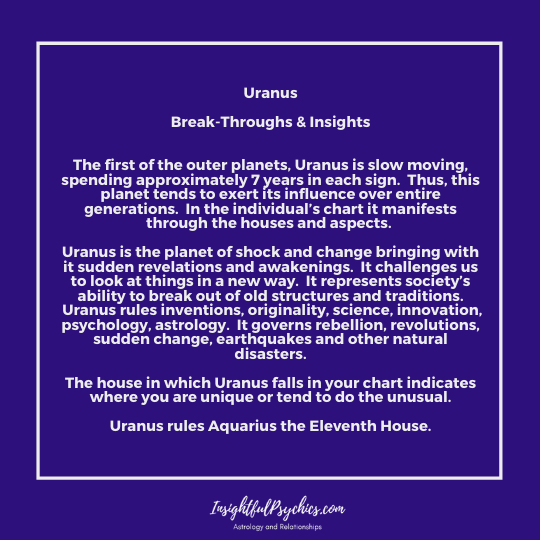
Other associations :
| Zodiac Sign | Aquarius |
| House | the eleventh House |
| Anatomy | the nervous system, especially the thyroid and pituitary |
| Color | teal |
| Metal | uranium |
| Gemstone | turquoise and malachite |
| Sense | clairvoyant |
| Symbol | the strength of Mars (the central part of the cross and circle) is split into 2 parts: a destructive and liberating part. |
Next Planet in Astrology: Neptune
Another not able aaaociation is when aspects are directly related to anything (especially personal planets) from the 10th house to the 4th. This can also highlight occupation, with a slight feeling of “fatedness.”
The upside down rotation and inclination of Uranus has a vital (and sometimes difficult) relationship to electron spin in human (and all animal) physiology on a molecular scale. This is so strong that it is one of the causes of human mortality through its 85-year orbit. Of course, life is strongly influenced by all the planets. But the orbit of Uranus is unusual, obscure and slowly lethal. Other heavy planets like Jupiter (22 y), Saturn, and Neptune (165 y) each have their particular influence. Jupiter affects puberty, Saturn influences maturity, Uranus affects lifetime, and Neptune may well be a goal for longevity if these factors are freed of the disastrous (if not understood) influence of Uranus on molecular activity, for instance in metabolism and chromosomes. It may take a long time to develop understanding and adapt to it, to increase human longevity to 150 years, though it looks like that is possible in the long run.
The rotation axis of Uranus not only causes its poles to alternate facing the sun each of its orbital periods, as you so kindly present (nobody else said it that I know, probably because it is one of their secrets) but has another aspect that I had to find myself. It turns out the upside down rotation (spin) of Uranus causes a spin inversion in some or many of the complex organic molecules in life. This inversion puts some electron orbits into an inverted mode called “spin down”. It is well worth rooting out the Uranian influence from the normal spin patterns in one’s body. Some time is necessary to become familiar with it. The discharge of the spin-down influence took about two weeks when I found it. I think that upside down rotation is one of the causes for human longevity to be around the orbital period of Uranus.–about 85 years. It certainly is possible to live longer, for persons living over 100 years are famous for it. Just imagine; if the Uranian spin limit on longevity is conquered, human beings may live a period based on Neptune’s 165 years. Live long and prosper.
Li