
The Moon in Astrology: The Planet That Runs Your Emotional Life Whether You Know It or Not
Some links are affiliate links. We may earn a commission at no extra cost to you.
Moon Astrology
I represent your innermost emotional needs and rule the most instinctive part of you. I’m changeable and have more needs at certain times than others.
💡 Quick Answer: Your Moon sign in astrology reveals your emotional needs, instincts, and how you feel safe in relationships. It describes the automatic, unedited version of you, what you reach for when you stop thinking about it, and what you actually need from the people closest to you.
Why the Moon Matters More Than You Think in Love and Relationships
You can know someone’s sun sign and still feel like a stranger to them. That’s because the sun shows you who someone is trying to become. The Moon shows you who they already are, underneath all of it, when they’re tired, when they’re hurt, when they feel safe enough to stop performing.
✨ Still have questions about your situation? Get a personalized reading for just 99¢
Your Moon sign is the part of you that nobody has to convince you to be. It’s why you reach for certain people when you’re sad, why some environments feel like home instantly and others never do no matter how long you stay. It runs quieter than your ego and louder than your logic.
In relationships, your Moon is where most of the friction lives. Two people can share values, share goals, even share a bed, and still feel chronically unseen, because their emotional languages don’t match. Understanding your Moon doesn’t just tell you what you need. It explains why you need it the way you do, and why asking for it has always felt so complicated.
What Does the Moon Represent in Astrology?
The Moon moves faster than any other body in the birth chart, changing signs every two to three days and completing a full cycle in about 28 days. That speed is the first clue to what it governs. The Moon rules everything that shifts, fluctuates, and responds to the environment, the tides of a person’s emotional experience, the automatic reactions that happen before reason gets a chance to weigh in.
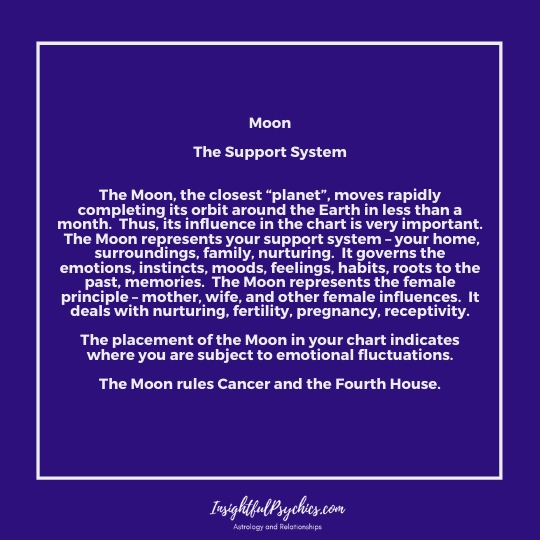
Where the sun represents identity and ego, the Moon represents the interior self. It is the part of the psyche that formed earliest, shaped by earliest caregiving, earliest comfort, earliest fear. The Moon rules Cancer and the 4th house, both of which center on home, family, and the places a person returns to in order to feel like themselves again. This is not coincidence. The Moon’s entire function in a chart is to point toward the emotional conditions a person needs in order to feel rooted.
Exalted in Taurus, the Moon steadies and deepens, finding security in the physical, the consistent, the sensory. In its detriment in Capricorn, emotional needs get pressured to be practical or productive. In fall in Scorpio, the Moon’s natural pull toward safety runs headlong into an environment that demands depth and exposure.
The Core Meaning — What the Moon Rules Over
The Moon rules emotions, instincts, memory, and the subconscious. But more specifically, it rules the automatic layer, the part of a person that reacts before they decide to. A Moon placement describes what triggers someone, what soothes them, and what they reach for when they stop thinking about it. It governs habits because habits are what the psyche builds when it’s trying to protect itself without expending too much energy. It governs the mother or primary caregiver because that relationship is where the emotional template gets written.
How the Moon Shows Up in Your Personality and Relationships
Your Moon sign explains the patterns you didn’t choose. The way you go quiet when something feels off, or the way you need to talk it through immediately or it festers. It’s why you feel safest in certain types of relationships and restless in others, even when everything looks fine on paper. Your Moon shows what you’re actually asking for when you say you feel disconnected. Learning it doesn’t just help you understand yourself. It gives you a way to explain your needs to someone else without it turning into an argument.
The Mythology and Symbolism of the Moon
In Roman mythology, the Moon was governed by three goddesses depending on her phase. Diana ruled her in the sky, full and bright and untamed. Hecate claimed her in the dark, when she vanished from the sky and moved through the underworld. Luna held the middle, the shifting, visible, human-facing face of the Moon that people watched to track seasons and time. Three faces, one body. That’s essentially what the Moon in astrology does in a chart. It holds the shifting, sometimes contradictory emotional reality of a person, the part of them that waxes and wanes depending on what’s around them.
Across cultures, the Moon has always been associated with water, cycles, and the inner life, because all three share the same quality: they move, they respond to forces outside themselves, and you can’t fully hold them still. The ocean follows the Moon because both are governed by pull, by gravity, by the invisible forces that make things move toward each other. The emotional self works the same way. It doesn’t reason itself into feeling. It gets pulled.
What sets the Moon apart from every other planet is that it reflects rather than generates. The Moon has no light of its own. It shows you the sun’s light from a different angle, at night, when defenses are down. Emotionally, this is what the Moon placement describes: how you receive and reflect experience back, filtered through your particular inner world.
The Glyph, the Energy, and the Vibe
The Moon’s symbol is a crescent, the exact shape of her most recognizable phase. A circle that hasn’t closed. Something receptive, curved, open on one side. As a glyph it captures the whole thing. The Moon in a chart doesn’t represent completion or arrival. It represents receptivity, the part of a person that takes things in and holds them, the cup before the contents are named.
How to Find the Moon in Your Birth Chart
To find your Moon sign, you need your birth date, your birth location, and your birth time. That last one matters more for the Moon than for almost any other placement, because the Moon moves fast, about 13 degrees a day. Two people born on the same day can have different Moon signs depending on the hour. If you don’t know your birth time, your birth certificate is the first place to look. Some countries record it there automatically. If yours doesn’t, a parent or hospital record can sometimes fill the gap.
Once you have those three things, any reputable birth chart calculator will pull it up in seconds. Look for the symbol ☽ or just look for “Moon” listed with a sign next to it. That’s your Moon sign. The house number next to it tells you which area of life your emotional needs tend to cluster around, which is a separate layer of meaning worth exploring once you have the basics.
If you genuinely can’t find your birth time, astrologers use a technique called rectification to estimate it, or they’ll work with a noon chart as a placeholder and note that the Moon’s sign might be off by one. It’s not ideal, but even a rough Moon sign can be more accurate than no information at all.
What Your Moon Placement Actually Means for How You Love
Your Moon placement describes what makes you feel held versus hollow in a relationship. It’s not about what you think you should want. It’s about what you actually need at 2am when something went wrong and you’re not editing yourself. Some Moon signs need to talk it through. Others need to be left alone to process before they can connect. Some need physical closeness, routine, and stability. Others need proof that the relationship can survive intensity. Knowing your Moon placement is the difference between asking for what you need clearly and spending years being quietly resentful that someone couldn’t figure it out on their own.
The Moon Through the 12 Zodiac Signs — What It Means for You
Moon in Aries
Your emotional reflex is action. When something upsets you, sitting with it feels impossible, like trying to hold still while something burns. You feel your way through by doing, moving, deciding. The risk is that you can mistake speed for resolution and find the same hurt waiting when you slow down. Learning to let feelings arrive fully before you react is the work.
Moon in Taurus
You feel most like yourself when your environment is steady and your senses are fed. A good meal, a familiar space, the same person who shows up the same way every time. The Moon is exalted here because Taurus gives it what it needs most: stability. But that same need for constancy can make change feel like a threat even when the change is good for you.
Moon in Gemini
Your emotional processing runs through language. You think out loud, talk through feelings in real time, and need someone who can keep up with the way your inner world moves. The problem is that sometimes words become a way to stay in your head and avoid sitting in the feeling itself. The people who reach you best are the ones who can hold a conversation and a silence.
Moon in Cancer
The Moon rules Cancer, which means it operates here without friction or compromise. You feel everything, early and deep, and you remember it. Your emotional memory is long and accurate, the kind that can recall the exact tone of voice someone used three years ago. That attunement makes you extraordinarily empathic. It also means you carry a lot that was never yours to begin with.
Moon in Leo
You need to be seen and not just acknowledged, genuinely witnessed in what you’re feeling. When someone minimizes your emotions or meets your warmth with detachment, it doesn’t just sting. It registers as rejection. The gift here is that you bring a kind of emotional generosity that makes people feel lit up around you. The growth is learning that not every relationship can give you the audience you need, and that’s not always a reason to leave.
Moon in Virgo
Your feelings arrive pre-analyzed. Before you’ve even named the emotion, you’re already cataloguing it, looking for what caused it, what it means, what to do about it. This is the Moon moving through Mercury-ruled territory, where everything gets sorted and examined. The habit of translating emotion into problem-solving can serve you, but sometimes the feeling just needs to be felt without a solution attached.
Moon in Libra
You feel most at ease when the people around you are at ease. Conflict in your environment doesn’t just bother you. It settles into your body like weather, and you find yourself adjusting, smoothing, calibrating without quite deciding to. This comes from Venus ruling Libra, which makes harmony a genuine emotional need. The edge is that you can lose track of what you actually feel when you’re too busy managing everyone else’s comfort.
Moon in Scorpio
The Moon is in fall here, which doesn’t mean it’s broken. It means the Moon’s preference for safety and the Scorpio environment’s demand for depth and exposure are always in tension. You don’t do surface-level emotional contact. You need to know what’s underneath, in others and in yourself, and anything that feels withheld from you reads as a threat. Trust, once earned, is absolute. Once broken, it’s very rarely repaired.
Moon in Sagittarius
You process emotion by moving outward rather than inward. Physically, literally, philosophically. A conversation about ideas can feel more emotionally nourishing to you than a direct talk about feelings, and that baffles people who experience emotion as something to sit with rather than explore. You need freedom inside your relationships, not because you’re avoidant, but because confinement actually disrupts your ability to feel connected at all.
Moon in Capricorn
The Moon in detriment here means there’s a built-in friction between the Moon’s need to feel and Capricorn’s instinct to control or suppress what isn’t useful. You learned early to manage your emotions rather than express them, to keep functioning even when something hurt. That’s a real skill. It’s also a ceiling. The people who get the most from you are the ones who made it safe enough for you to put the competence down.
Moon in Aquarius
Your emotional world runs slightly detached from the immediate moment. You can observe your own feelings with a kind of curious distance that other people find either fascinating or frustrating. This comes from Aquarius sitting in Saturn’s traditional rulership, where structure and objectivity have always outranked pure feeling. You connect deeply through ideas and shared vision. Where you can grow is in learning that proximity, physical and emotional, is its own kind of language.
Moon in Pisces
The boundary between your feelings and other people’s feelings is thin. Not broken, thin. You absorb emotional atmosphere the way fabric absorbs water, without trying, without always noticing it’s happening. This comes from Pisces dissolving the Moon’s edges rather than containing them. The people who are good for you create calm rather than chaos, because you will feel whatever is in the room whether or not it belongs to you.
The Moon Through the Houses — A Brief Overview
Where the Moon sits by house in the birth chart shifts the location of a person’s emotional center of gravity. A Moon in the 1st house wears its emotional state publicly, visibly, sometimes without meaning to. A Moon in the 7th house finds emotional grounding primarily through partnership, feeling most settled when there’s a significant other to orient toward. A Moon in the 12th house processes emotion privately and inwardly, often without fully naming what it’s experiencing even to itself.
The house placement adds the where to the Moon sign’s how. The sign describes the texture and mechanism of your emotional needs. The house describes which part of life those needs tend to cluster around most persistently. Both matter. Neither is complete without the other. Each house placement carries its own full picture, more than a brief summary can hold.
The Moon and Love Compatibility — How You Connect With Others
What the Moon Reveals About Your Relationship Style
Your Moon sign shapes what you’re actually asking for when you say you need more from someone. It determines whether you feel loved through consistency or intensity, through being left alone or being drawn out. It also shapes how you read other people’s emotional states, and what you unconsciously expect from them. Two people can have genuine affection for each other and still miss each other emotionally if their Moons are working in different frequencies. Compatibility at the Moon level isn’t about similarity. It’s about whether your needs can coexist without one person constantly sacrificing theirs.
Moon Compatibility — The Most Harmonious Connections
Moons in the same element speak the same basic emotional language. Two water Moons (Cancer, Scorpio, Pisces) tend to feel each other without having to explain themselves. Two earth Moons (Taurus, Virgo, Capricorn) find comfort in the practical and the predictable, which makes them feel steady together. Fire Moons (Aries, Leo, Sagittarius) feed each other’s energy rather than draining it. Air Moons (Gemini, Libra, Aquarius) find emotional connection through ideas, conversation, and mental movement. Moons in complementary elements, earth and water, fire and air, can also work beautifully when both people understand that they meet differently but genuinely.
Moon Compatibility — The Most Challenging Connections
The most friction tends to show up between Moons in square or opposition, signs that share a modality but not an element. A Scorpio Moon and a Leo Moon are both fixed, both intense, both deeply loyal, but the way each processes vulnerability is almost opposite. Scorpio pulls inward and tests before trusting.
Leo reaches outward and needs to feel met. Neither is wrong. But without awareness, each reads the other as withholding or overwhelming. The saving grace in these pairings is that the intensity is real on both sides. It’s not lack of feeling that causes conflict. It’s two strong feelings pointing in different directions.
The Moon in Your Daily Life — How This Energy Shows Up in Real Life
You probably already know your Moon is active when you find yourself suddenly in a mood you can’t fully explain. That’s the Moon doing its job. It picks up on shifts in your environment, in your relationships, in your body, before your conscious mind has processed anything. The habits you run on autopilot, the foods you reach for when you’re stressed, the specific way you need to decompress after a hard day, all of that is Moon behavior, your psyche running the routines it built to keep you feeling safe.
Your Moon also shows up in who you call first when something happens. Not who you think you should call. Who you actually call. The people who hold your Moon well are the people who make the inside of you feel like it’s allowed to exist. You know them by how your body responds when they walk in a room.
The Moon changes signs every two to three days, so the current lunar cycle affects everyone in a general way. When the Moon is in a sign that squares or opposes your natal Moon, you’ll often feel it without knowing why. Things feel harder, smaller, more charged. When the Moon transits your natal Moon’s sign, the opposite can happen. Something that usually requires effort just flows.
How to Work With Your Moon Energy in Relationships
The most direct thing you can do is learn what your Moon sign actually needs and start asking for it out loud. Not hinting, asking. Your emotional needs are not unreasonable, even the ones that feel embarrassing to admit. The second thing is to learn your partner’s Moon sign and take it seriously, not as a list of their flaws but as a map of where they’re trying to feel safe. Needs that look like stubbornness or withdrawal or drama almost always look different once you understand what they’re actually protecting.
What Happens When the Moon Goes Retrograde?
Unlike the outer planets, the Moon never actually goes retrograde. It moves consistently and directly through the zodiac, which is part of why it governs the habitual and the automatic rather than the reviewed and reconsidered. The Moon’s transits work more like weather than like a recurring event you can plan around.
What does happen are lunar eclipses, which function like an amplified full Moon and can bring sudden emotional clarity or disruption, and void-of-course periods, when the Moon has made its last major aspect in a sign before moving into the next one. Astrologers often note that decisions made during void-of-course Moon periods tend not to stick, and that it’s worth understanding these windows if you’re someone who makes big choices under emotional pressure. A dedicated look at how the lunar cycle affects decision-making and timing is worth exploring separately for a fuller picture.
What Your Moon Is Really Telling You
Your Moon is not the problem. It never was. It’s the part of you that learned, very early, what it needed to feel okay, and built every habit, preference, and emotional reflex around protecting that. Some of those protections still serve you. Some of them outlived their usefulness a long time ago.
The work isn’t to fix your Moon or suppress it or evolve past it. The work is to understand it well enough to tell the difference between a genuine need and a fear-based pattern wearing the costume of a need. That distinction changes everything.
When you stop explaining away your emotional reality and start treating it as information, you stop expecting the people around you to read your mind. You know what you need. You ask for it. You notice faster when something isn’t working. You pick people whose Moons can actually coexist with yours, not because they’re identical, but because they’re compatible in the ways that matter.
Your Moon has been trying to tell you something about yourself for a long time. The question worth sitting with isn’t what’s wrong with how you feel. It’s what would change if you actually listened.
Other Associations
| Zodiac Sign | Cancer |
| House | the fourth |
| Anatomy | the stomach, breasts, uterus, and the lymph |
| Colour | white, cream, silvery grey, and to a lesser extent green |
| Metal | Silver |
| Gemstone | all iridescent stones: moonstone, labradorite, opal. Also: pearl, carnelian, milk quartz, amber |
| Day | Monday |
Next planet in astrology: Mercury