
7th House in Astrology: The Mirror You Keep Falling In Love With
Some links are affiliate links. We may earn a commission at no extra cost to you.

💡 Quick Answer: The 7th house in astrology governs committed relationships, marriage, and binding partnerships. The sign on your 7th house cusp, called the Descendant, reveals the qualities you seek in a long-term partner and the patterns you keep repeating until you understand them.
Most people find astrology through their sun sign. Then they discover the houses, and everything shifts. The 7th house shifts astrology from personality to relationships. It focuses on the people you choose to connect with in your life.
✨ Still have questions about your situation? Get a personalized reading for just 99¢
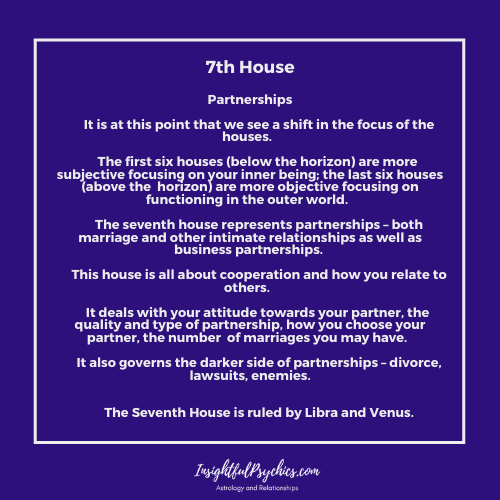
This is the house of committed relationships, marriage, business partnerships, and contracts. Not just romance in the butterflies sense, but the kind that involves paperwork, shared finances, and showing up for someone on the hard days. It includes anyone you make a formal agreement with. This could be a spouse, a business partner, or someone involved in a legal dispute.
The 7th house sits directly opposite the 1st house on the chart wheel. That placement is not accidental. The 1st house is all about you, your identity, how you move through the world alone. The 7th house is where that self meets its counterpart. It represents the shift from “what I want” to “what we build together.”
In astrological tradition, the 7th house is associated with Libra and Venus. Venus governs attraction, value, and what we find worth keeping close. Libra brings the drive toward balance, fairness, and mutual exchange. Together they give the 7th house its reputation for harmony, but also its tendency to expose where you are out of balance.
7th House Meaning: What This Part of Your Chart Actually Covers
The 7th house is one of four angular houses, meaning it sits at a structural turning point on the wheel. Angular houses carry more weight than others because they represent the four pillars of a life: self, home, partnerships, and public role. The 7th is the partnership pillar, and everything it governs flows from that core function.
What this function covers is wider than many think. It goes beyond romance to include any binding, one-to-one agreement between equals. If the relationship involves a formal contract or mutual obligation, the 7th house has something to say about it.
The house works by showing you what you seek in others, and more usefully, why you keep seeking it. The sign on the cusp, any planets inside, and the ruling planet’s condition all create a clear view of your partnership patterns. This holds true throughout your life.
If you’re brand new to house systems, think of the 12 houses as 12 areas of life. The 7th house is about committed bonds with others. It focuses on formal relationships, not just friendships or family.
Descendant Sign: What Your 7th House Cusp Reveals
The cusp of the 7th house has a specific name: the Descendant, or DSC. It sits directly on the western horizon of your chart, the point where the sun was setting at the moment you were born. That image is worth sitting with. The setting sun represents something leaving the solo, visible self and moving into connection with another.
The Descendant is the geometric opposite of your Ascendant, which marks how you present yourself to the world. Where the Ascendant describes the mask you lead with, the Descendant describes what you are unconsciously looking for in someone else. Many people feel uneasy with their Descendant sign at first. This sign shows a part of themselves they haven’t fully embraced yet.
Think of this cusp as a filter. Every long-term partner who passes through your life passes through this degree first. The sign on your Descendant colors what you find magnetic, what you keep choosing, and sometimes what keeps blindsiding you. It is the exact boundary between your private inner world and the public relational one.
The sign on your 7th house cusp tells you a lot about your relationship patterns before you even look at what’s inside the house.
To find your Descendant, you need your birth time as well as your birth date and location. Without an accurate birth time, the house cusps in your chart won’t be reliable.
7th House and Marriage: How It Shapes Long-Term Romance
You stop dating someone casually and something quietly shifts. The relationship moves from fun to deliberate. That shift is 7th house territory. This house covers the legal and emotional ties of long-term romance. It includes marriage, long cohabitation, and any lasting union. These connections are meant for commitment, not just exploration.
The 7th house shows your relationship blueprint, meaning the specific traits and qualities you are wired to seek in a life partner. Someone with Aries on the 7th house cusp often finds themselves drawn to bold, independent, even challenging partners. Someone with Pisces on that cusp may keep attracting sensitive, artistic, or elusive ones. The pattern usually isn’t random.
This is also the house that governs the evolution from casual to committed. The 5th house rules dating, flirtation, and romance in its early, playful form. Once you move into “I want to build something with this person,” you have crossed into 7th house terrain. The energy here is less about chemistry and more about compatibility, the kind that holds up over years.
The sign on your Descendant and any planets inside the 7th house together paint a picture of what commitment looks and feels like for you specifically. Not what it should look like. What it actually tends to.
7th House and Business Partnerships: Including Open Enemies
Not every important relationship in your life is romantic. The 7th house also covers the person you start a business with, the long-term client you keep renewing contracts with, and the colleague you bring in as a co-founder. Any professional alliance that involves mutual obligation and formalized agreement lives here.
Here is where it gets interesting. The 7th house also rules open enemies, meaning the people who oppose you directly and face-to-face. This is not hidden betrayal, that belongs to the 12th house. This is the rival you know about, the person on the other side of a lawsuit, the competitor who challenges you publicly. The reason enemies and partners share a house is that both relationships require you to engage with someone as an equal. Both demand you show up.
The projection piece is worth understanding too. The 7th house often reflects what you haven’t integrated about yourself. The traits you keep seeing in your partners, and even your enemies, are frequently traits you carry but haven’t acknowledged. Someone who keeps attracting chaotic partners may have unexpressed chaos of their own. The house acts like a mirror and the reflection isn’t always flattering.
Choosing business partnerships with awareness of your 7th house can save years of friction. The same patterns that show up in romance tend to show up in professional contracts.
Open enemies in astrology doesn’t mean someone who hates you. It means someone whose opposition to you is known and direct. A competitor who publicly challenges your work qualifies. A friend who quietly undermines you belongs to a different house entirely.
1st House vs 7th House: Understanding the Self and Partnership Axis
There is a tightrope built into your chart. The 1st house pulls toward individual identity, personal goals, and self-sufficiency. The 7th house pulls toward compromise, shared goals, and genuine interdependence. Every person with strong placements in either house feels this tension at some point.
The 1st and 7th house axis is sometimes called the “me versus we” axis because that is exactly what it is. Too much energy in the 1st house and you can struggle to make space for a partner’s needs without feeling like you’re losing yourself. Too much pull toward the 7th, and you can lose your own identity in relationships, shaping yourself around whoever you’re with.
The healthiest expression of this axis is not balance in the soft, passive sense. It’s two fully formed people choosing each other. The 7th house works best when the 1st house is doing its job, when you are grounded in who you are before you ask someone else to meet you there.
Your partnerships will reflect where this axis is out of alignment. The same partner showing up in different bodies is often a sign that the 1st house needs attention.
If you keep feeling like you disappear in relationships or lose your sense of direction when you’re with someone, that’s the 1st and 7th house axis asking for your attention, not just a personality trait.
Planets in the 7th House: What Each Placement Means
A planet in the 7th house is not subtle. Whatever that planet governs becomes a recurring theme in your close partnerships, sometimes in beautiful ways, sometimes in ways that take years to understand.
Venus in the 7th house draws in affectionate, devoted partners fairly easily. The house is Venus’s natural territory, so her energy here flows without much friction. Jupiter here tends to bring expansive, generous unions and often marks someone who genuinely benefits from marriage or partnership in a measurable way, better finances, broader opportunities, a sense of luck through others.
Mars in the 7th brings heat. Relationships tend to be passionate and activating but conflict is a recurring feature because Mars governs assertion and desire, and in the 7th those qualities play out through other people. Saturn here is the long game. Early relationships may feel restricted or heavy, but over time Saturn builds something durable. Uranus in the 7th tends to attract unconventional partners and resist traditional structures, sometimes dramatically.
The planet is not a verdict. It is a description of what the relationship classroom tends to look like for you.
Other planets matter here too. The Moon in the 7th often pulls someone toward emotionally nurturing partners. Neptune can bring idealization or a tendency to see partners as you wish they were rather than as they are. Mercury tends to prioritize mental connection and communication in long-term bonds.
Empty 7th House: What It Actually Means for Love and Partnerships
An empty 7th house does not mean you won’t have meaningful relationships. Most people have several empty houses and the vast majority of them get married, form partnerships, and build lasting bonds. The absence of a planet just means the house does not carry concentrated natal energy in that area.
When the 7th house is empty, the planet ruling the sign on the cusp steps in as the guide for that area of life. If Gemini sits on your 7th house cusp, Mercury becomes your relationship ruler. Mercury’s sign, house placement, and the aspects it receives in your chart will describe how your partnerships tend to unfold. This is called the ruling planet or house lord, and it carries real weight.
The mistake people make is reading emptiness as absence of love or luck. It isn’t. It often just means relationships are not the central lesson or challenge of this lifetime. Some of the most beautifully partnered people in the world have empty 7th houses.
What matters is where the ruling planet sits and how it is aspected. That is where the story actually lives.
Having no planets in the 7th also doesn’t mean relationships will feel easy or uncomplicated. The ruling planet can carry plenty of tension depending on how it sits in your chart. Empty just means no concentrated natal focus, not no activity.
7th House Ruler: How to Find It and What It Tells You
Pull up your natal chart and look at the sign sitting on your 7th house cusp. That sign has a ruling planet, and that planet is your relationship ruler. Aries on the cusp means Mars rules your 7th. Taurus or Libra points to Venus. Scorpio gives you Pluto, with Mars as a secondary ruler. Each sign has a clear ruler you can look up in about thirty seconds.
Once you have the planet, find it in your chart. The house it occupies shows you where and how you are most likely to meet significant partners. Someone with their 7th house ruler in the 9th house often meets people through travel, education, or diverse cultures. Someone with it in the 2nd house may find that relationships are deeply tied to finances and shared values around money.
The aspects this planet receives sharpen the picture. A 7th house ruler conjunct Jupiter suggests partnerships that feel abundant and expansive. One conjunct Saturn points to relationships that are serious, sometimes delayed, and built to last or not at all. The condition of this planet can tell you more about your marriage potential than almost anything else in the chart.
An “aspect” just means the angular relationship between two planets in your chart. Conjunct means they sit close together. A square creates friction. A trine tends to flow easily. Any basic astrology glossary can walk you through the main ones.
7th House Transits: When Planets Move Through and Shift Your Relationships
Slow-moving planets crossing your 7th house cusp tend to mark real-world relationship milestones. Saturn transiting the 7th house is one of the most reliable markers for serious commitment, or for a serious reckoning with a relationship that has run its course. It does not always bring romance but it almost always brings clarity about what is working and what is not.
Jupiter in the 7th house often brings growth in relationships. This can mean partnerships, engagements, weddings, or new business ties. It’s a time when making connections feels easier. It opens doors. The catch is that Jupiter can raise unrealistic hopes. So, not every relationship that begins during Jupiter’s transit through the 7th will last.
Uranus and Pluto transits here tend to shake things up at a structural level. Uranus can bring sudden entries or exits of partners. Pluto tends to strip away whatever was not built on solid ground. Neither is inherently bad, but both will force you to look honestly at what your partnerships are actually made of.
Transits through the 7th are worth tracking because they give you context for why relationship themes are suddenly louder in your life.
A transit only affects your 7th house if you know your accurate birth time. Without it, you can’t reliably know which planets are moving through which houses at any given point.
Faster-moving planets like Venus and Mars also transit the 7th house regularly, usually for a few weeks at a time. These shorter windows can bring flirtations, minor contract activity, or a temporary uptick in social connection, but they rarely trigger the big milestones the slower planets do.
7th House Takeaways: What This Part of Your Chart Is Really Teaching You
The 7th house keeps showing you the same thing from different angles: you cannot fully know yourself without genuine encounter with another person. Not in the passive sense. In the kind that requires negotiation, visibility, and the willingness to be seen without performing.
A well-understood 7th house does more than explain your love life. It connects to every other area of the chart because partnerships, when they’re solid, create stability that radiates outward. Business ventures become more possible. Creative risks feel more supported. The goals scattered through the rest of your chart have better footing when the 7th house is working.
The point is not to find a perfect partner. The point is to understand what you are actually bringing to the table and what you are unconsciously asking someone else to carry for you. That distinction changes everything.
Your 7th house is less a love forecast and more a self-portrait seen from the outside in.
What does your seventh say about your relationships?
Taurus falls on my 7th house. My fiancee is a Virgo Sun and Taurus Moon. (My Sun is Pisces and we balance each other out perfectly anyway.) We both expect the same things out of a relationship so there is no head-butting whatsoever. We happened upon each other with what I would call divine timing, so it is my belief that finding her was a karmic reward. Everything about the Descendant and how it reflects committed partnership has been 110% accurate for me.